Position as Junior Research Group Leader (m/f/d) for Sub-Standard Quantum Limit of Interferometry
As part of the Cluster of Excellence QuantumFrontiers, the QUEST Leibniz Research School in cooperation with the Faculty for Mathematics and Physics invites applications for the position of a Junior Research Group Leader (m/f/d) for Sub-Standard Quantum Limit of Interferometry (Salary Scale 14 TV-L, 100 %) to be filled as of November 1st, 2021. The position is limited to four years.
Information on the position and the application process is available on the AEI homepage.
DetailsDamping electro-optic modulator acoustic resonances with epoxy
At the prototype we use a lithum niobate New Focus (now Newport) 4004 broadband electro-optic modulator (EOM) as part of our reference cavity frequency stabilisation servo. During measurements we noticed that the EOM contained high-Q resonances at around 790 kHz and 2 MHz which looked mechanical in origin:
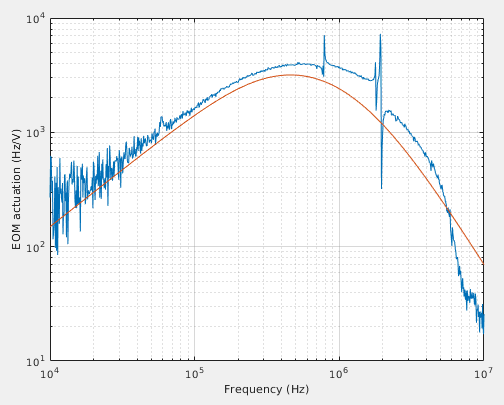
These resonances appear on the light as unwanted frequency modulation. The presence of the 790 kHz resonance creates instability in our servo, preventing us from pushing its unity gain frequency higher. A higher unity gain frequency would allow for greater suppression of laser frequency noise in the 100 Hz to 1 kHz band of the reference cavity, which in turn would reduce coupling of frequency noise to the main SQL interferometer where it would otherwise show up as a significant noise source masking the quantum noise that we wish to measure.
In passing, Sean mentioned this to our colleague Rana Adhikari in Caltech, who recalled some old “crystal lore” that mounting the lithium niobate on acoustically impedance matched material can reduce acoustic resonances. This gave Sean and Harald the idea to test this hypothesis by applying damping material to the crystal in a spare New Focus 4004.
(more…) Details